
CELPIP Blog
CELPIP Time Management Techniques for Every Test Section
A practical pacing plan for all four CELPIP skills
- Listening: capture keywords instead of trying to write full sentences, then answer while the details are fresh.
- Reading: use personal time checkpoints and make your best choice before one difficult question consumes the section.
- Writing: reserve separate time for planning, drafting, and a final check of purpose, tone, and grammar.
- Speaking: use preparation time to note two or three ideas, then begin promptly and keep a clear beginning, middle, and end.
Apply the plan in a free timed CELPIP practice test, then adjust the checkpoints based on where you lose time.
Time management for CELPIP test sections: 2026 guide

TL;DR:
- Effective time management is vital in CELPIP to finish sections confidently without running out of time.
- Practicing under real exam conditions and timing every section helps build pacing and stamina essential for success.
Effective time management in CELPIP test sections is the single skill that separates candidates who finish confidently from those who run out of time on the final question. The CELPIP General test covers four fixed sections: Listening, Reading, Writing, and Speaking, each with strict time limits and no room for improvisation. Knowing the official time allocations and pairing that knowledge with proven techniques gives you a real edge. Candidates who book their test at least 30 days in advance also build in the preparation window needed to practise these strategies properly.
How is time allocated across the CELPIP test sections?
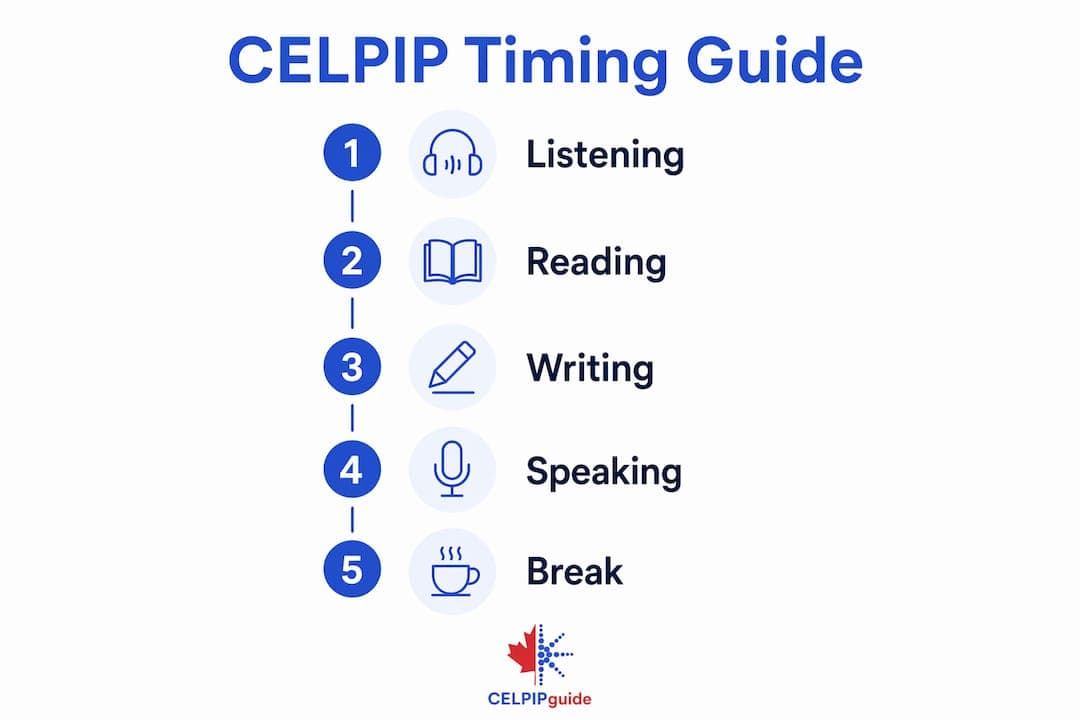
The CELPIP General test runs approximately three hours and contains four sections in a fixed order. There are no breaks between sections within each block, though an optional short break is available between the Listening/Reading block and the Writing/Speaking block. Understanding this structure is the foundation of any solid timing plan.
| Section | Time Limit | Key Tasks |
|---|---|---|
| Listening | 47–55 minutes | Six task types; audio plays once only |
| Reading | 55–60 minutes | Four parts; inference and application focus |
| Writing | 53–60 minutes | Two tasks: email and survey response |
| Speaking | 15–20 minutes | Eight tasks; strict per-task time windows |
The Listening and Reading sections demand the most sustained concentration because they run back to back. The Speaking section is the shortest but the most time-pressured per task. Knowing these numbers before test day removes guesswork and lets you allocate mental energy where it counts most.
Pro Tip: Use the optional break between blocks to reset. Stand up, breathe, and drink water. Two minutes of recovery protects your focus for the Writing and Speaking sections.
What techniques help with time in Listening and Reading?
The Listening section plays audio exactly once. That single-play rule makes note-taking efficiency the most critical skill in this part of the test. You cannot rewind, so every second of active listening must produce usable notes.
The Two-Column Split method is the most reliable technique for Listening. Draw a quick vertical line on your on-screen notepad and label one side “Main Point” and the other “Counter/Detail.” As the audio plays, you map the speaker’s intent on the left and opposing viewpoints or supporting details on the right. This real-time mapping lets you answer inference-based questions in seconds rather than scanning through scattered notes.
For the Reading section, the passages are short but dense. The questions test inference and application, not literal recall. That means conceptual matching using synonyms and context beats word-for-word searching every time. When you read a question, identify the concept it is testing, then scan the passage for the idea expressed in different words.
Practical tips for both sections:
- Use abbreviations in your notes: “S” for speaker, “A” for agree, “D” for disagree, and an arrow symbol for “leads to.”
- Practise the on-screen notepad before test day. It behaves differently from paper and requires its own muscle memory.
- In Reading, apply the Person-Point Grid: list each person or group mentioned and their position. This cuts through complex multi-perspective passages quickly.
- Focus on synonyms first when scanning. The correct answer almost never uses the exact words from the passage.
Pro Tip: Never spend more than 90 seconds on a single Reading question. If you are stuck, mark your best guess and move on. Unanswered questions cost more than wrong answers.
How do Writing and Speaking sections reward good pacing?
The Writing section gives you 53–60 minutes for two tasks. Task 1 is an email response and Task 2 is a survey-style written response. Many candidates waste time searching for impressive vocabulary instead of writing clear, well-structured sentences. Avoiding overcomplicated vocabulary and focusing on clear structure is more effective than trying to impress under time pressure. A well-organised response at CLB 9 beats a vocabulary-heavy but disjointed one every time.

Allocate your Writing time deliberately. Spend roughly five minutes planning each task, then write, then use the final two minutes to check spelling and grammar using the built-in spell check. Do not overthink the spell check. A quick scan is enough.
For Speaking, the time pressure is intense because each task has a strict window of 30–60 seconds depending on the task type. Short daily practice sessions of around 20 minutes outperform occasional long cramming sessions for building fluency and pacing confidence. Recording yourself and listening back builds what CELPIP evaluators call “Listenability,” which is how easy your response is to follow.
Key habits for Writing and Speaking:
- Plan before you type or speak. Even 30 seconds of mental outlining prevents rambling.
- Use spatial vocabulary in Speaking tasks that involve describing images. Phrases like “in the foreground” or “to the left of” signal clarity to evaluators and fill time purposefully.
- Practise writing task structure with timed examples so the format becomes automatic.
- Do not re-record Speaking responses during practice. Committing to your first attempt builds the real-time confidence you need on test day.
Pro Tip: For Speaking, aim to complete your answer two to three seconds before the timer ends. Cutting off mid-sentence hurts your score more than a slightly shorter response.
What tools and practice methods build real timing skills?
Building timing skills requires practising under conditions that match the actual test. Reading about time management is not enough. You need to feel what three hours of continuous focus demands from your brain and body.
| Practice Method | Timing Benefit | Recommended Frequency |
|---|---|---|
| Full-length mock exam under strict time limits | Builds mental stamina and realistic pacing | Once per week in final month |
| 20-minute daily Speaking drills | Improves fluency and per-task pacing | Daily |
| Timed Reading sets (one section at a time) | Trains conceptual matching speed | Three to four times per week |
| On-screen notepad practice | Replicates digital note-taking ergonomics | Every Listening practice session |
| Recording and reviewing Speaking responses | Identifies pacing and clarity gaps | Daily |
Candidates who complete at least one full-length simulation test under strict timed conditions before their test date show stronger pacing on test day. That is because stamina is a skill, not a given. Refraining from pausing or rewinding during practice simulates the real endurance demand of the test.
Create a quiet environment for every practice session. Background noise tolerance is worth building, but your primary practice space should mirror a test centre: no phone notifications, no background music, and a timer running at all times.
Pro Tip: Do a microphone check and a headset test before your Speaking practice sessions. Technical issues on test day are rare, but being familiar with the equipment removes one source of anxiety.
What are the most common timing mistakes on the CELPIP test?
Most timing failures on the CELPIP test come from a small set of predictable habits. Recognising them before test day is the fastest way to fix them.
Common mistakes and how to correct them:
- Dwelling on difficult questions. Set a personal rule: if you cannot answer within 90 seconds, choose your best option and move on. Returning to a question later is rarely possible within section time limits.
- Ignoring the on-screen timer. Glance at the timer after every two to three questions. Candidates who check time only at the end of a section frequently discover they have five minutes left for ten questions.
- Skipping note-taking in Listening. Some candidates believe they can hold audio content in memory. They cannot. The six Listening task types include complex inference questions that require written reference points.
- Over-editing Writing responses. Editing is good. Re-writing entire paragraphs under time pressure is not. Write a clean first draft with a plan, then edit once.
- Anxiety-driven rushing. Rushing produces careless errors that cost more points than slow, careful work. Controlled breathing between tasks resets your pace without wasting significant time.
“Candidates who follow section timings precisely and practise under real test conditions consistently outperform those who rely on content knowledge alone. Timing is a skill. Practise it like one.”
Key takeaways
Consistent timed practice across all four CELPIP sections is the most reliable path to a high CLB score on test day.
| Point | Details |
|---|---|
| Know the time limits | Listening runs 47–55 minutes, Reading 55–60, Writing 53–60, and Speaking 15–20 minutes. |
| Use the Two-Column Split | Map speaker intent and opposing details in real time to answer Listening questions faster. |
| Match concepts, not words | In Reading, scan for synonyms and ideas rather than exact phrases to save significant time. |
| Practise daily in short sessions | Twenty-minute daily drills build fluency and pacing more effectively than infrequent long sessions. |
| Simulate full test conditions | Complete at least one full-length timed mock exam before test day to build mental stamina. |
What I have learned about timing after watching hundreds of CELPIP candidates
The most overlooked timing skill in CELPIP is not speed. It is pacing consistency. I have seen candidates blaze through the first half of Reading and then stall completely on the final passage because they spent their mental energy too early. The test does not reward sprinting. It rewards steady, controlled effort across three hours.
The candidates who improve fastest are the ones who treat timing as a separate skill from language ability. They practise with a timer every single session, not just on full mock days. They review their CLB 9 targets and work backwards from the score they need, identifying which sections cost them the most time and fixing those first.
My honest advice: stop practising without a timer. Every untimed session teaches your brain that time is flexible. It is not. The CELPIP test is a fixed clock, and your preparation should reflect that reality from day one. Clarity and completion beat complexity and incompleteness every single time.
— Reza
Celpipguide practice tests built for real timing conditions
Celpipguide offers over 100 full-length mock exams and 5,000 practice questions, all timed to match official CELPIP section limits. Every test mirrors the real exam format so you build pacing skills alongside language skills, not separately.
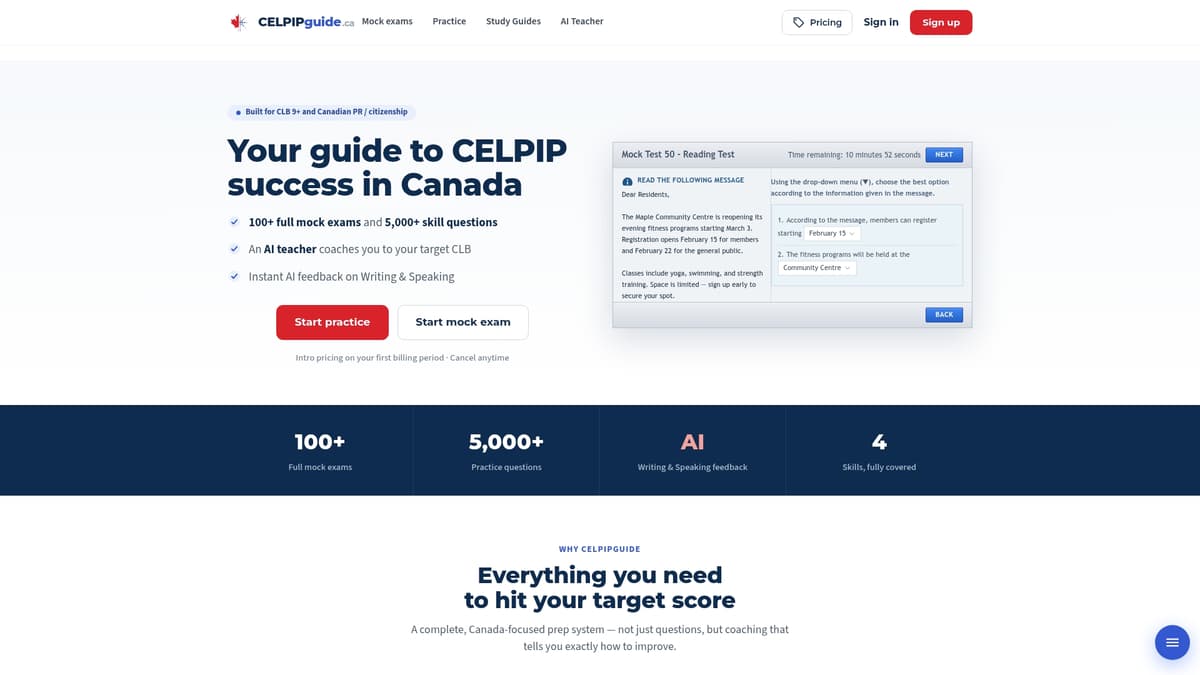
The CELPIP exam practice hub includes section-specific timed tasks for Listening, Reading, Writing, and Speaking, plus instant AI feedback on your written and spoken responses. You can also access free speaking practice with sample answers and structure guides to sharpen your per-task pacing. If you are serious about hitting your CLB target, timed practice with real feedback is the most direct path there.
FAQ
How long is the CELPIP General test in total?
The CELPIP General test lasts approximately three hours, covering Listening, Reading, Writing, and Speaking in a fixed order with an optional break between the two blocks.
Can I take notes during the CELPIP Listening section?
Yes. The test provides an on-screen notepad for note-taking during Listening. Practising with this digital tool before test day is critical because it handles differently from paper.
How many tasks are in the CELPIP Speaking section?
The Speaking section contains eight tasks completed within 15–20 minutes total. Each task has a strict individual time window, so preparing concise, structured responses is the most effective approach.
What is the best way to manage time in CELPIP Reading?
Use conceptual matching rather than word-for-word scanning. Identify the idea a question is testing, then look for synonyms and paraphrased versions of that idea in the passage to answer quickly and accurately.
How often should I do timed practice before my CELPIP test?
Daily short sessions of around 20 minutes for Speaking and three to four timed Reading sets per week build the strongest timing skills. Complete at least one full-length timed mock exam in the final month before your test date.