
CELPIP Blog
Turn One Sample into Real CELPIP Listening Score Gains with Mock Exams
Turn One Sample into Real CELPIP Listening Score Gains with Mock Exams

The official CELPIP-General Free Online Sample Test from Paragon Testing Enterprises is your authentic starting point, and CELPIPguide’s full-length mock exams turn that one sample into repeated, structured practice. The single best move today: sit down, treat the audio like the real exam, play it once, answer, then review your mistakes. Skip that step and every other tip in this guide loses most of its value.
TL;DR:
- Practicing under timed, exam-like conditions with a focus on analyzing errors greatly improves listening comprehension and reduces mistakes over time.
- Full-length mock exams help build stamina, while micro-drills target specific weak skills for more efficient progress.
- Authentic CELPIP samples focus on six distinct question types, with no rewind option on test day, so practice must emphasize real-time understanding.
- Repeated diagnostic practice using AI feedback and error logs accelerates skill development more effectively than passive listening to podcasts or videos.
- Improving from CLB 6 to CLB 7 is realistic with consistent dedicated effort over a few weeks, especially when focusing on targeted skill gaps.
Table of Contents
- Where to find authentic CELPIP listening samples
- What the CELPIP listening section actually contains
- How to turn a sample into real progress
- Choosing the right sample format for your study stage
- How listening scores map to CLB and citizenship requirements
- Two study plans built around listening samples
- Why authentic, test-like practice beats generic listening drills
- Get full mock exams and instant feedback with CELPIPguide
- Where to practise and verify your listening target
- Sources
- FAQ
Where to find authentic CELPIP listening samples
Start with the source itself. The official free sample test mirrors the real exam’s format and timing, though Paragon notes some interface differences from the live test. That makes it the gold standard for getting a first honest read on where you stand.
Once you’ve done that, you need volume, and that’s where a dedicated practice hub earns its keep. CELPIPguide’s listening practice pages give you full mock exams and task-specific drills built to mimic single-listen rules across all six parts.
Beyond those two anchors, look for:
- Single-task practice sets that isolate one listening skill at a time
- Downloadable audio you can replay for review sessions (not for your first attempt)
- Annotated answer sets that explain why an answer is correct, not just which letter it is
Free samples are great for familiarization, but they’re limited in number. Paid practice banks give you the repetition your ear actually needs, and most run fine on any modern browser or mobile device without special downloads.
What the CELPIP listening section actually contains
The listening section has six parts, and each one tests a different comprehension muscle. Knowing the shape of the test before you practise saves you from wasting samples on the wrong skill.
- Problem Solving — you follow a conversation where someone works through a real-life issue
- Daily Life Conversation — casual back-and-forth between two speakers on everyday topics
- Information — a monologue delivering facts, often with numbers or instructions to track
- News Item — a short broadcast-style report you must summarize mentally as it plays
- Discussion — two or more speakers debating a topic from different angles
- Viewpoints — speakers stating and defending distinct opinions on an issue
Total listening time runs roughly 47 to 55 minutes depending on the version of the test, and every clip plays exactly once. There’s no rewind button on exam day, so practising with replay enabled defeats the purpose. The accents you’ll hear are standard North American English, occasionally with mild regional variation, and the register shifts from casual chat to more formal reporting depending on the part.
How to turn a sample into real progress
Playing a sample once and moving on won’t move your score. What works is a three-stage loop: simulate, analyst, drill. Deliberate, structured practice consistently outperforms passive listening for score gains, and the method below is built around that principle from the CELPIP Listening Guide.
Stage one: timed simulation. Recreate exam conditions exactly. Close extra tabs, set a timer, play the audio once, and answer without pausing. Score yourself immediately afterward, before you forget your instinctive reactions.
Stage two: structured review. This is where most learners rush and lose the benefit of the sample entirely.
- Check the transcript, if one is provided, against what you actually heard
- Log every wrong answer with the specific reason (missed a number, misread tone, lost the thread mid sentence)
- Pull out unfamiliar vocabulary and add it to a running list
- Look for a pattern: are you losing points in Discussion but acing Information?
Stage three: targeted drills. If your error log points to one weak part, drill that part specifically for a few days rather than doing another full mock right away.
Note-taking during Stage one matters more than most people think. For Information and News Item sections, jot down numbers, names, and times as symbols, not full words, since audio never repeats. For Discussion and Viewpoints, track which speaker said what with a quick initial or arrow so you’re not guessing who held which opinion when the questions come.
Pro Tip: Alternate your single-listen simulations with separate replay-and-analyse sessions on different days. The simulation trains your brain to comprehend in real time; the replay session builds awareness of the specific error patterns you keep repeating.
Choosing the right sample format for your study stage
Not every sample suits every stage of preparation. Matching the format to your goal saves time and avoids burnout.
- The official free sample is best used once, early, purely for familiarization with format and interface. Don’t treat it as your main practice tool since there’s only one.
- Full mock exams simulate the entire test length, which is essential once you’re past the basics and need to build listening stamina and stay sharp through all six parts back to back.
- Question banks and micro-drills let you hammer one weak task type repeatedly, which is far more efficient than sitting through a full mock every time you want to fix one problem.
- AI-scored practice gives you instant, consistent feedback on comprehension accuracy, useful for daily practice. Human-reviewed feedback tends to add more nuance around tricky inference questions, though it’s slower to get.
- Prefer browser-based or mobile-friendly platforms so you can practise anywhere without juggling downloaded files, though downloadable audio still has a place for offline review.
One more detail worth flagging: official test rules generally don’t let you return to a previous page once you’ve moved on, while some sample tests do permit backtracking. If your sample allows it, disable that habit deliberately. Practising with a safety net you won’t have on exam day teaches you the wrong instincts.
How listening scores map to CLB and citizenship requirements
CELPIP scores each skill on a 12-point scale, and that scale converts directly to Canadian Language Benchmark (CLB) levels used across immigration programs. If your goal is citizenship, IRCC requires a listening and speaking score of 4 or higher on CELPIP-General or CELPIP-General LS as proof of language ability.
Many immigration streams ask for considerably higher, often CLB 7 or above, so check your specific program’s threshold before setting a target. Use your early mock scores as a baseline, then aim for small, steady jumps rather than a single leap. A move from CLB 6 to CLB 7 is a realistic few weeks of focused work, not an overnight fix.

Two study plans built around listening samples
The two week intensive suits anyone with an exam date already booked:
- Days 1 to 3: daily timed single-listen simulations using different sample sets, logging every error
- Days 4 to 10: mix simulations with targeted drills on your weakest one or two parts
- Days 11 to 13: taper slightly, focus on note-taking speed and vocabulary gaps
- Day 14: one full mock exam under strict conditions as a final check
The four week balanced plan works better if your test date is further out:
- Week 1: build foundational skills, vocabulary lists, note-taking shorthand, no full mocks yet
- Week 2: introduce task-specific micro-drills alongside vocabulary work
- Week 3: add one full mock exam, review thoroughly, adjust focus based on the error log
- Week 4: second full mock early in the week, light targeted review after
Aim for 30 to 45 minutes of focused listening practice most days, and give yourself at least a day of rest between full mock exams. Your brain needs that gap to actually absorb the corrections from your last review.
Pro Tip: Never do two full mock exams back to back. Cramming mocks without reviewing between them just repeats the same mistakes at higher speed.
Why authentic, test-like practice beats generic listening drills
Most learners default to podcasts and YouTube clips, assuming any English listening helps. It doesn’t help nearly as much as CELPIP-format practice, because the test rewards very specific skills: single-listen retention, rapid note-taking, and tracking multiple speakers under time pressure. Generic listening builds general comprehension, not that particular muscle.
What actually moves scores is structured, diagnostic practice: simulate, find your weak spots, drill them, repeat. Measure every attempt against your last one, and let the pattern in your errors decide what you study next, not a generic checklist.
— Reza
Get full mock exams and instant feedback with CELPIPguide
Official samples get you started, but one free test only takes you so far. CELPIPguide gives you the volume and feedback loop that a single sample can’t: over 100 full-length mock exams, thousands of practice questions across all four skills, and an AI teacher that scores your listening comprehension instantly so you’re not guessing where your errors come from.
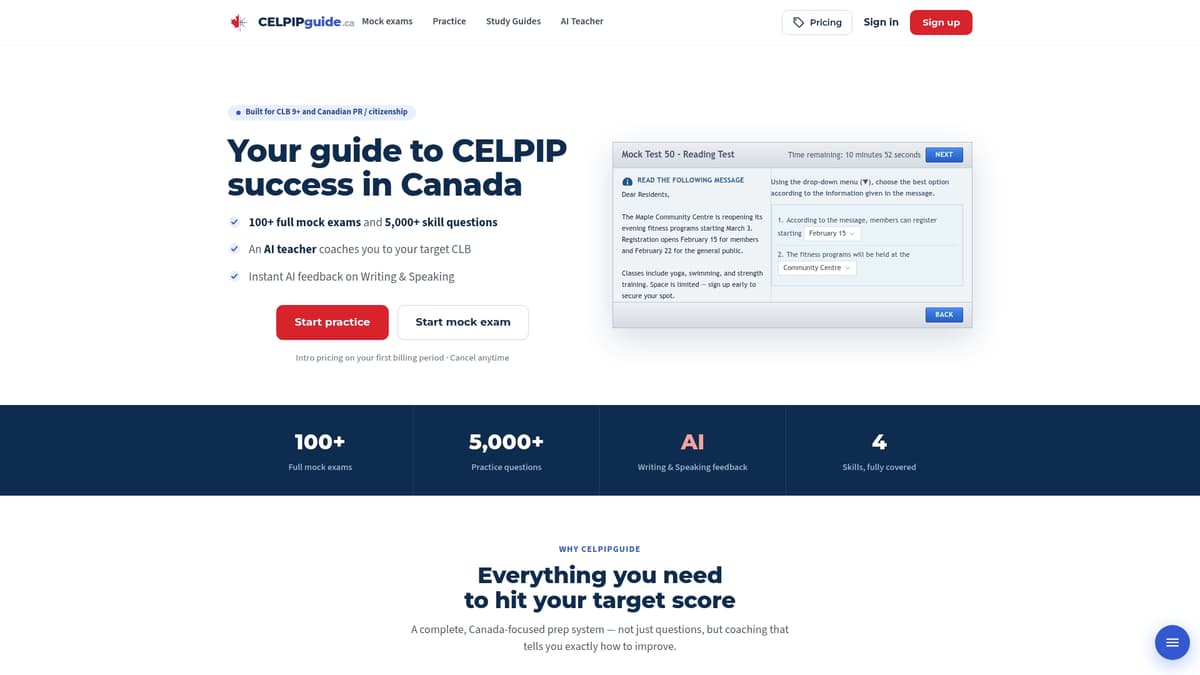
Both study plans above lean on exactly this kind of repeated, diagnostic practice. Whether you’re running the two week intensive or the four week balanced plan, CELPIPguide’s practice hub slots directly into your review stage, flagging weak parts so your drills target the right skill instead of wasting time on what you’ve already mastered.
Ready to move past the one free sample? You can purchase the Plus plan for a one-time fee and use code BLG30 for a discount on your access to full mock exams, task drills, and personalized study plans.
Where to practise and verify your listening target
- CELPIPguide listening practice hub
- IRCC citizenship language proof requirements
- If you’re also polishing job or immigration paperwork alongside your CELPIP prep, professional resume guidance for Canadian applicants is a useful parallel resource.
Sources
FAQ
What is 32 out of 38 in CELPIP listening?
CELPIP listening isn’t reported as a raw score out of a fixed item count, since the exact number of scored questions can vary between test versions. Your result is converted to the 12-point CELPIP scale, which then maps to a CLB level. If you’re seeing a raw score from a practice platform, check that platform’s own conversion guide rather than assuming a fixed formula.
Is CELPIP listening easier than IELTS?
Neither test is objectively easier since they test similar skills differently. CELPIP uses exclusively North American English and computer-delivered audio played once, while IELTS includes British and Australian accents and allows more time to preview questions. Many test-takers who are already comfortable with Canadian English find CELPIP’s listening more approachable simply due to accent familiarity.
Is 7 a good CELPIP score?
A CELPIP score of 7 in listening generally corresponds to CLB 7, a level accepted by many economic immigration streams and well above the CLB 4 minimum IRCC requires for citizenship language proof. Whether it’s “good enough” depends entirely on your specific program’s requirements, so check your target stream before treating 7 as a finish line.
Can you provide some examples of speaking samples for the CELPIP speaking test?
Speaking samples typically cover tasks like giving advice, describing a scene, and comparing two options within a strict time limit per task. CELPIPguide’s speaking guide walks through sample prompts, vocabulary, and task-by-task tips for each of the eight speaking tasks on the exam.