
CELPIP Blog
Stop Guessing: AI CELPIP Study Plan with 3 week and 9 week Templates
Stop Guessing: AI CELPIP Study Plan with 3 week and 9 week Templates

Start with an AI diagnostic to find your real CLB gaps, then follow a personalised plan built on daily micro-drills and scheduled AI-scored mock tests until your scores hold steady at your target. This beats unguided practice because the AI scores your speaking and writing against real rubrics and maps every result straight to CLB, so you know exactly what to fix each week. We built CELPIPguide around this exact loop.
TL;DR:
- A diagnostic test provides a clear skill-level baseline, timing, and error types that guide a personalized, focused study plan rather than unguided practice.
- Daily micro-drills targeting specific weaknesses and regular full mock exams under test conditions offer more effective progress than long, unfocused study sessions.
- AI feedback breaks performance down into rubric categories, enabling targeted fixing of the most significant CLB gaps, especially those more than one level below the target.
- Achieving a stable target CLB score requires three consecutive full mocks at or above that level, not just one strong performance.
- Consistency and specificity are key, with short daily practice prioritized over long marathon sessions, and progress mapped directly using AI score breakdowns.
Table of Contents
- Your step-by-step AI study plan and weekly workflow
- How to personalise your study using AI feedback
- Ready-made schedules you can start this week
- What to practise and how to run realistic mock tests
- Tracking progress and mapping scores to your CLB target
- Why the AI approach works, and what backs it
- Our editorial take: stop treating CELPIP prep like a content marathon
- Get started with the Plus plan
- FAQ
- Sources
- Official references and primary sources
Your step-by-step AI study plan and weekly workflow
Every solid plan starts the same way: with a diagnostic, not a guess. A good CELPIP diagnostic test should tell you three things clearly. First, a per-skill CLB estimate for listening, reading, writing, and speaking, so you know your starting point in each area rather than a vague overall impression. Second, how you perform under timing pressure, since CELPIP rewards pacing almost as much as accuracy. Third, the specific error types dragging your score down, whether that’s weak task fulfilment in writing or hesitation in speaking fluency.

Once you have that picture, set a weekly time budget that matches your gap. A one-CLB gap might need several hours a week. Larger gaps usually require a more intensive weekly commitment. Be honest about what you can sustain for weeks, not days.
From there, the weekly workflow looks like this:
- Monday to Friday: daily micro-drills of 5 to 25 minutes, each one targeting a specific weak subskill from your diagnostic.
- Twice a week: a longer focused session (30 to 45 minutes) on your lowest-scoring skill, followed immediately by AI feedback review.
- Weekend: one consolidation session where you revisit mistakes from the week and redo a similar task to confirm the fix stuck.
- Every one to two weeks: a full-length AI-scored mock test under real exam conditions.
The micro-drills matter more than they sound like they should. A 10-minute speaking drill on describing a scene, repeated daily with instant AI feedback, builds fluency faster than one long weekly session because you’re training the skill while the previous correction is still fresh.
Here’s a simple way to map drill time to weak areas:
- Vocabulary gaps: 5 to 10 minutes daily on CLB-banded word lists and usage in context.
- Grammar accuracy: 10 to 15 minutes daily on targeted error patterns from your writing feedback.
- Speaking fluency: daily 60 to 90 second responses to prompt cards, recorded and AI-scored.
- Listening comprehension: 15 to 20 minutes daily with note-taking practice under time pressure.
- Reading speed: 15 minutes daily on timed passages matched to CELPIP question formats.
Schedule your first full mock once you’ve completed about two weeks of targeted drills, then every one to two weeks after that. Mocks tell you whether the micro-drills are translating into real exam performance, which is the only number that actually matters.
How to personalise your study using AI feedback
A diagnostic is only useful if you know how to read it. Good AI feedback breaks your performance into rubric categories rather than a single score, and that breakdown is where your study plan should come from.
For writing, expect separate marks for content and coherence, vocabulary, grammar and sentence structure, and task fulfilment. For speaking, expect content, vocabulary, grammar, and fluency or pronunciation. These categories matter more individually than your overall score, because two people with the same overall mark can have completely different problems.
Use a simple prioritisation rule:
- Fix the category that’s more than one CLB level below your target first. That’s your severe gap and your biggest point of leverage.
- Maintain categories that are already at or near target with light weekly practice so they don’t slip.
- Treat task fulfilment and coherence as early priorities in writing, since they’re often the quickest to correct once you understand the expected structure.
- Treat pronunciation and fluency as slower-moving targets in speaking, needing daily repetition rather than occasional review.
The loop itself is straightforward: submit a response, get scored feedback, do two or three focused drills on the weakest category, then resubmit a similar task and compare. If your score on that category rises, move to the next weakest area. If it doesn’t, you likely misread the feedback, so slow down and reread the rubric comments before drilling again.
Pro Tip: Keep every AI-scored writing and speaking response in one folder with the date and score. Watching the trend line matters more than any single result.
Switch from training mode to exam simulation once your weakest category sits within half a CLB level of your target across two consecutive attempts. That’s the signal you’re ready to test under full timing and format pressure rather than isolated drills.
Ready-made schedules you can start this week
Pick the template that matches your timeline. Both assume you’ve already taken a diagnostic.
3-week rapid boost (for a one-CLB gap, 8 to 10 hours per week):
- Week 1: daily micro-drills on your two weakest skills, one AI-scored full task per day, mid-week mock on listening and reading only.
- Week 2: continue drills, add daily speaking and writing submissions with AI feedback, one full mock at the end of the week.
- Week 3: two full mocks, with drills focused only on whatever the mocks reveal as still weak.
9-week progressive build (for a two- to three-CLB gap, 8 to 12 hours per week):
- Weeks 1 to 3: diagnostic review, daily micro-drills across all four skills, one focused session per weak skill twice weekly.
- Weeks 4 to 6: full task practice with AI feedback daily, first full mock at week 5, second at week 6.
- Weeks 7 to 9: mocks every 5 to 7 days, drills narrowed to whatever categories still lag behind target.
Daily micro-drill templates:
- 5-minute drill: one vocabulary set review or one short speaking prompt, recorded and scored.
- 15-minute drill: one writing paragraph on a CELPIP-style prompt with AI feedback review.
- 30-minute drill: one full writing or speaking task plus a focused redo of the weakest scored section.
If your available hours are tighter, keep the daily micro-drills nonnegotiable and reduce mock frequency instead. Consistency on short daily practice beats occasional long sessions every time.
What to practise and how to run realistic mock tests
Not all practice is equal, so sequence it by skill.
- Writing: start with Task 1 (email) since its structure is more formulaic, then move to Task 2 (survey response) once your paragraphing is solid.
- Speaking: work through the eight speaking tasks in order of difficulty for you personally, giving extra reps to the ones involving giving opinions or describing unusual situations, since these trip up most learners.
- Listening: practise conversation-based and problem-solving question types first, since they carry the most questions.
- Reading: prioritize the diagram and viewpoint passages, since timing pressure hits hardest there.
When you run a mock test, treat it exactly like exam day. Sit in a quiet room, use the same device and headset setup you’ll use on test day, time every section strictly, and capture your written and spoken answers the same way the real test would. Skipping any of these makes your AI-scored result less reliable as a predictor.
After each mock, read the AI breakdown by category, not just the overall score, and build next week’s micro-drills directly from whichever two categories scored lowest. That keeps every week’s practice tied to actual evidence instead of guesswork.
On frequency: if your baseline is within one CLB of your target, run two full timed mocks in your final two weeks. If your gap is larger, space mocks every 7 to 10 days throughout your plan so you have time to react to each result.
Tracking progress and mapping scores to your CLB target
Official guidance confirms that CELPIP scores map directly to Canadian Language Benchmarks, with per-skill thresholds. For example, CLB 9 requires a minimum score of 9 in each of the four abilities, and higher immigration categories often require CLB 7, 9, or 10 or above depending on the program.
Log these every week:
- Your per-skill score from each mock or AI-scored task.
- The change from your previous attempt in each rubric category.
- Timing: whether you finished within the official limits.
- Recurring error types flagged by the AI feedback.
One statistic worth building your timeline around: CELPIP results are valid for two years from the report date when used for Express Entry and similar programs, so plan your test date with that window in mind rather than retesting too early or too late.
Readiness comes down to one simple rule: you’re ready when you hit your target CLB in three consecutive timed mocks, not just one strong attempt.

Why the AI approach works, and what backs it
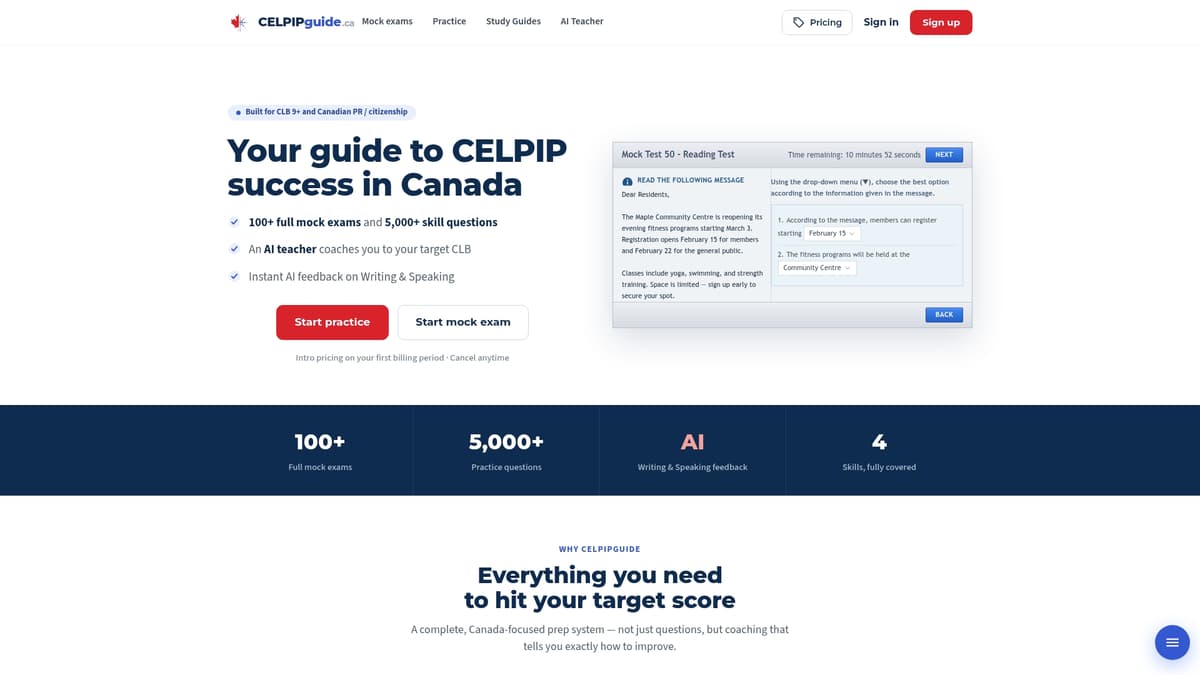
The core advantage of an AI-first plan is specificity. Instead of general advice, you get rubric-level scores that point to exactly which subskill needs work, which is what makes daily micro-drills effective instead of random. Our platform backs this workflow with more than 100 full mock exams and over 5,000 practice questions built around CELPIP task types, plus AI that builds a personalised plan from your diagnostic and scores writing and speaking instantly against the real rubric categories.
I’ve spent time working through CELPIP prep materials and watching where learners actually get stuck, and the pattern is consistent: people plateau not from lack of effort, but from practising without specific feedback on what to fix next.
Our editorial take: stop treating CELPIP prep like a content marathon
Most CELPIP advice still pushes marathon study sessions and generic practice tests, and that’s backwards. The biggest gains come from short, targeted repetition against real rubric feedback, not from grinding through hours of unfocused practice.
The conventional wisdom overrates volume and underrates specificity. Doing fifty writing tasks without rubric-level feedback teaches you very little, because you keep repeating the same errors without knowing it. Doing ten tasks with clear AI feedback on content, grammar, and task fulfilment teaches you considerably more, because every attempt corrects something specific.
What readers consistently underestimate is how much pacing and task fulfilment cost them, compared to raw grammar or vocabulary. A technically correct response that misses the task’s actual requirements scores worse than a simpler one that nails the format.
If you take one thing from this: prioritize diagnostic-driven, short daily practice over long irregular sessions, and let your scored feedback decide what you study next, not your gut feeling about what feels weak.
— Reza
Get started with the Plus plan
We built a Plus plan around this workflow: take the diagnostic, get a personalised study plan, practise with daily AI feedback on writing and speaking, and work through full mock exams while tracking your progress by skill.
Here’s how to start this week:
- Take the diagnostic test to get your per-skill CLB estimate and error breakdown.
- Follow your first one-week plan using the daily micro-drills it generates.
- Schedule your first full AI-scored mock once the week is done.
Get started with Plus.
FAQ
How long does it take to improve one CLB level with AI study tools?
It depends on your weekly hours and starting gap, but most learners following a structured plan with daily micro-drills and regular mocks see steady movement within three to nine weeks. Consistency in daily practice matters more than total study time.
What does an AI diagnostic test actually measure for CELPIP?
A proper diagnostic measures your current CLB level in each of the four skills, your timing under exam conditions, and the specific error types affecting your scores. This per-skill breakdown is what a personalised study plan should be built on.
How many practice questions or mock exams should I complete before test day?
There’s no fixed number, but working through a broad question bank alongside multiple full-length mocks gives you a realistic sense of readiness. Our platform offers over 100 full mock exams and 5,000-plus practice questions to support that volume of practice.
How do I know if my CELPIP scores are high enough for Express Entry or citizenship?
Check the official CLB mapping for your program, since requirements vary by category and can require CLB 7, 9, or higher in each skill. Also confirm your result validity window before booking your test.
Can AI feedback replace traditional study methods entirely?
AI feedback works best alongside traditional methods like vocabulary review and reading practice, rather than replacing them outright. Use AI scoring to identify exactly what to fix, then reinforce it with the kind of deliberate reading and writing practice you’d do on your own.
Official references and primary sources
For broader immigration planning context, see this partner guide on partner visa applications: partner guide on partner visa applications.